
Compare each out the door price in Pennsylvania in 2026 using the same vehicle specifications, registration details, and purchase conditions. Get the complete number in writing, separate dealer charges from government taxes and registration fees, and compare financing and trade-in terms separately.
- Compare the out the door price for matching vehicles, not advertised discounts or monthly payments.
- Separate dealer charges, government taxes, registration fees, and optional products before choosing an offer.
- Best Out The Door suits new-car buyers seeking competing binding offers from verified franchised dealers in their area.
- Confirm every offer uses the same registration details, incentive qualifications, and purchase conditions.
How do you compare out-the-door prices in Pennsylvania?
Use the same request for every dealer. Then compare complete written offers rather than trying to reconcile different assumptions after the offers arrive.
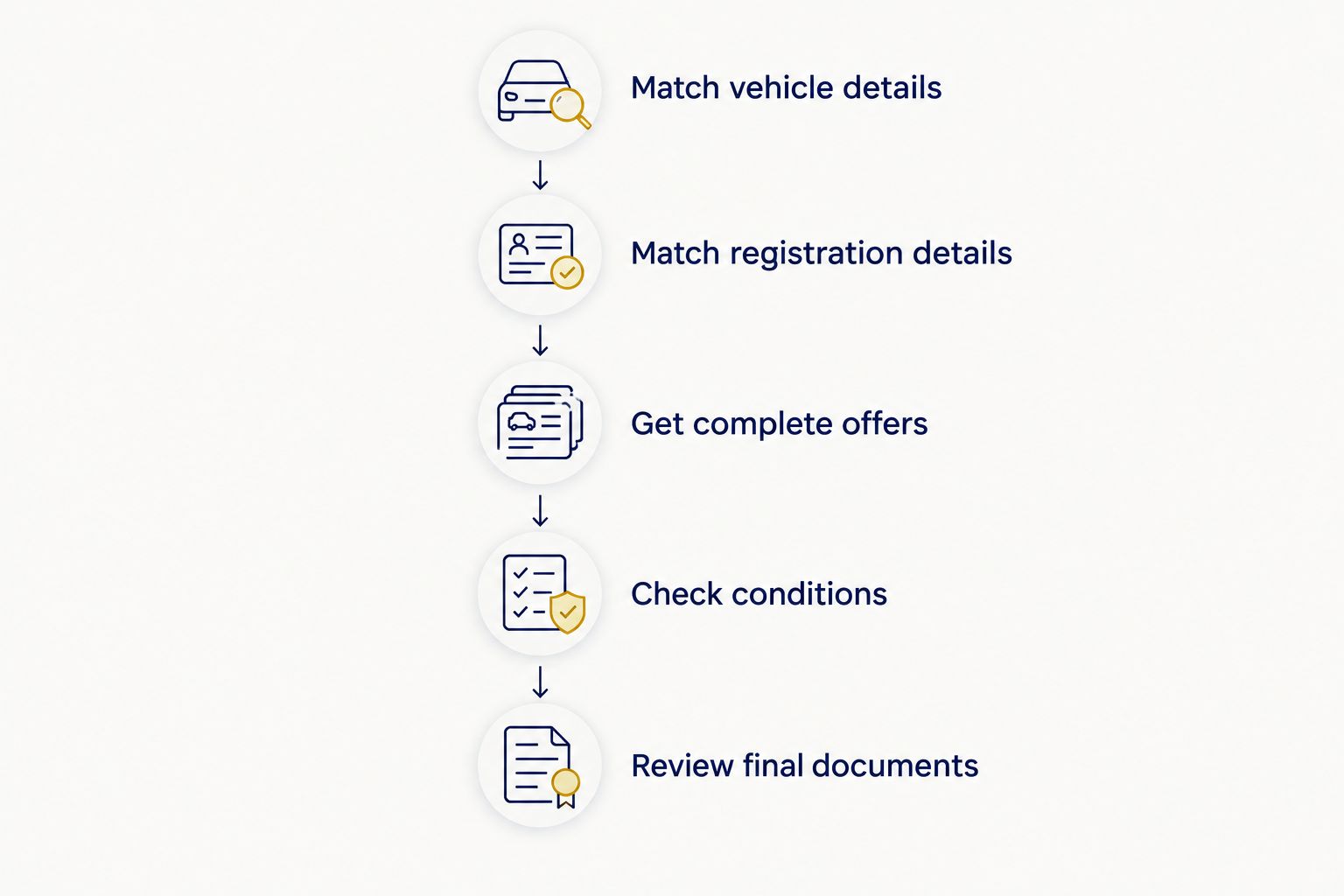
Organize your 2026 comparison into 3 quote sections: vehicle, charges, and conditions. Keep the vehicle specification fixed, identify every charge, and record anything you must do to receive the quoted number.
1. Match vehicle details
Specify the model year, make, model, trim, drivetrain, and required equipment. If you have selected a particular vehicle, ask the dealer to identify it by its vehicle identification number, or VIN.
Different equipment means you are comparing different purchases. A lower total does not establish better value when the vehicle lacks something you requested.
2. Match registration details
Give each dealer the same buyer and registration information. State where you intend to title and register the vehicle, rather than asking dealers to assume that their location determines every government charge.
Ask each dealer to identify the assumptions behind its tax and registration calculation. Resolve conflicting assumptions before ranking the totals.
3. Get complete offers
Request the vehicle selling price, dealer charges, government taxes, title and registration charges, and any additional products. Ask for the complete out-the-door number alongside the itemization.
The total lets you compare. The itemization tells you what you are comparing. Neither replaces the other.
4. Check conditions
Identify any financing requirement, trade-in requirement, or incentive qualification attached to the offer. Ask whether the same total applies without an optional product you do not want.
An offer with a condition is not automatically a poor offer. It belongs in your comparison only when you understand and meet that condition.
5. Review final documents
Compare the accepted offer with the buyer's order or purchase agreement before signing. Check the vehicle, complete total, included products, and conditions.
If something differs, ask the dealer to explain and reconcile it. Do not treat an unexplained difference as a rounding issue.
Why this matters
A vehicle advertisement, an out-the-door offer, and a loan payment answer different questions. Treating them as interchangeable hides the difference between the purchase total and the way you pay it.
For a Pennsylvania purchase in 2026, start with the complete transaction rather than a headline discount. A detailed offer also gives the dealer a clear record of what you requested and what you expect to sign.
| Comparison basis | Best for | What it shows | What it leaves unresolved |
|---|---|---|---|
| Vehicle selling price | Reviewing the vehicle component | The agreed vehicle price before other transaction charges | Taxes, registration, dealer charges, and additional products |
| Complete out-the-door offer | Comparing the purchase total | The vehicle and included transaction charges | Loan interest and other financing terms require separate review |
| Monthly payment | Checking the proposed payment against your budget | The payment under a particular financing arrangement | Purchase total, term, down payment, and total borrowing cost |
Use the complete out-the-door offer to compare purchases. Use loan disclosures to compare financing. A payment that fits your budget does not, by itself, establish which purchase is better.
What belongs in a complete out-the-door number?
A useful offer shows the full amount required for the agreed vehicle purchase and identifies its components. Ask for itemization even when the dealer has already provided a clear total.
Vehicle selling price
Check that the selling price refers to the exact vehicle or specification requested. Keep any listed discounts and incentives visible so you can review their conditions.
Do not compare discount amounts in isolation. Different starting prices and different equipment can produce different totals despite similar advertised discounts.
Dealer charges
Ask the dealer to identify charges assessed by the dealership and explain what each covers. Do not assume that a charge becomes a government requirement because its label includes administrative language.
The comparison should show whether each dealer charge is included in the quoted total. A charge disclosed separately still needs to be accounted for before you choose an offer.
Government taxes and registration fees
Keep government charges separate from dealer charges. Ask which amounts relate to tax, title, registration, or another identified government requirement.
For a Pennsylvania transaction, verify applicable tax treatment with the Pennsylvania Department of Revenue and title or registration requirements with PennDOT. Use current official guidance and your actual transaction details, not a remembered rate or another buyer's receipt.
Additional products
Identify service contracts, protection products, accessories, and other additions individually. Ask which are already included and which are choices you have not accepted.
An included product changes what the offer buys. Compare matching packages, or ask for a revised offer that reflects the products you actually want.
Why out-the-door offers vary
Different totals do not automatically indicate a problem. They can reflect different vehicles, different included items, or different assumptions that need clarification.
Check these factors before deciding that a dealer has offered the better complete number:
- Vehicle specification: Trim, drivetrain, equipment, and accessories must match your request.
- Dealer charges: Compare the included charges and their descriptions, not just the vehicle selling price.
- Registration assumptions: Confirm that each calculation uses the same buyer and registration details.
- Incentive eligibility: Separate offers you qualify for from offers that depend on conditions you do not meet.
- Additional products: Identify whether each total includes the same products and services.
- Purchase conditions: Record any financing or trade-in requirement attached to the offer.
Do not remove government charges from your comparison simply because they are not dealer revenue. They remain part of the amount you need to understand. Keep the categories distinct while comparing the complete transaction.
How should you request comparable written offers?
Send every dealer the same specification and questions. Clear requests reduce the need for dealers to interpret what you mean by a complete price.
Use this 2026 request checklist:
- Identify the vehicle and required equipment.
- Provide the intended title and registration information.
- Request an itemized, complete out-the-door number.
- Ask whether any incentive requires a specific qualification.
- Ask whether the offer requires dealer-arranged financing or a trade-in.
- Identify additional products you want included or excluded.
- Ask how long the offer applies and what changes require a revised offer.
Keep the response with its date and vehicle identification. If you change the specification, registration details, or requested products, ask for an updated total rather than editing the dealer's offer yourself.
A comparable offer needs matching assumptions, not matching formatting. Dealers can present information differently and still provide everything required for a fair comparison.
How do you compare financing without losing the purchase total?
Set the vehicle transaction alongside the loan terms, not inside a monthly-payment discussion. Ask for the out-the-door number and the financing details as separate parts of the proposal.
Review the annual percentage rate, loan term, amount financed, down payment, and disclosed borrowing costs. A change to the down payment or repayment term changes the payment comparison even when the vehicle purchase total stays unchanged.
If a vehicle offer depends on financing through a particular lender or program, record that condition. Compare the complete purchase and financing arrangement before deciding whether the offer meets your needs.
Avoid treating the amount financed as another name for the out-the-door number. A down payment, trade-in, existing loan payoff, or financed product can change how the transaction moves from purchase total to loan balance.
Should you include your trade-in when comparing offers?
Keep the trade-in visible as a separate part of the transaction. Request the vehicle purchase total, trade-in allowance, and any existing loan payoff without collapsing them into a single unexplained balance.
A trade-in can affect the transaction calculation. Ask the dealer to show any resulting tax treatment and verify that treatment against current official guidance for your circumstances.
Compare the purchase first, then review the trade-in's effect on the transaction. If an offer requires your trade-in, record that requirement beside the total rather than treating the offer as unconditional.
Is a written offer enough before you sign?
A written offer gives you a reference point, but the final documents still need review. For your 2026 purchase, compare 2 documents: the accepted offer and the final purchase agreement.
Check the vehicle identification, purchase total, dealer charges, government charges, additional products, and any incentive conditions. If financing is involved, review the credit documents separately as well.
Ask the dealer to explain a changed amount before signing. A correction to buyer information or an agreed change in products should be visible, not buried in a different total.
Keep the final version of the offer rather than relying on an earlier message. The relevant comparison is between the purchase you accepted and the purchase documented for your signature.
Where a quote marketplace fits
Best Out The Door is best for new-car buyers who want competing binding out-the-door offers from verified franchised dealers in their area. You submit a request and compare the resulting offers.
The benefit is a complete-number comparison from participating dealers. The limitation is scope: do not treat participating-dealer offers as a survey of every dealership, and do not assume every location has the same dealer participation.
Use Best Out The Door to request offers. Apply the same checks to each response: matching vehicle, matching registration assumptions, clear conditions, and a complete total.
A marketplace does not replace your review of the final purchase agreement. It gives you offers to compare; you still choose the dealer and confirm the documented transaction.
FAQ
What is the best way to compare an out the door price in Pennsylvania?
Compare complete written offers for matching vehicles using the same buyer, registration, and purchase assumptions. Separate dealer charges from government taxes and registration fees, then check every condition attached to the total.
Does the out-the-door number include loan interest?
The out-the-door number describes the vehicle purchase total, not the total interest paid over a loan. Review the financing disclosures separately to understand the borrowing cost.
Should I compare monthly payments instead of complete offers?
Compare complete offers before comparing monthly payments. Different down payments, loan terms, and borrowing costs can produce different payments for the same purchase total.
How do I check Pennsylvania taxes and registration charges in 2026?
Check current Pennsylvania Department of Revenue guidance for tax treatment and PennDOT guidance for title and registration requirements. Ask the dealer to identify the transaction details used in its calculation.
Can I ask a dealer to remove products I do not want?
Ask the dealer for an offer without products you do not want and confirm whether the revised offer changes any other conditions. Compare the revised complete number, not a total you adjusted yourself.
Does a binding offer mean I can skip reviewing the purchase agreement?
No. Compare the purchase agreement with the accepted offer before signing, including the vehicle, complete total, included products, and conditions.
Does Best Out The Door replace the dealership?
No. Best Out The Door lets new-car buyers request competing binding out-the-door offers from verified franchised dealers in their area. You compare the offers and choose your dealer.
One last thing
The lowest total is only the lowest comparable offer when it buys the vehicle and terms you requested. A missing accessory or an incentive you cannot qualify for changes the comparison.
Before accepting an offer in 2026, ask the dealer to confirm 1 final number: the complete out-the-door total for the agreed purchase. Keep that confirmation with the itemization and compare both with the final documents.